
plenoptic.models.LinearNonlinear#
Note
This object is a torch.nn.Module. It therefore has all the methods and attributes
from that class, even though they are not documented here (to avoid cluttering this page).
- class plenoptic.models.LinearNonlinear(kernel_size, on_center=True, amplitude_ratio=1.25, pad_mode='reflect', pretrained=False, activation=<built-in function softplus>, cache_filt=False)[source]#
Bases:
ModuleLinear-Nonlinear model.
This model applies a difference of Gaussians filter followed by an activation function.
Model is described in Berardino et al., 2017 [4] and online [5], where it is called LN.
- Parameters:
kernel_size (
int|tuple[int,int]) – Shape of convolutional kernel.on_center (
bool(default:True)) – Dictates whether center is on or off; surround will be the opposite of center (i.e. on-off or off-on).amplitude_ratio (
float(default:1.25)) – Ratio of center/surround amplitude. Applied before filter normalization.pad_mode (
str(default:'reflect')) – Padding for convolution.pretrained (
bool(default:False)) – Whether or not to load model params from Berardion, 2018 [6]. See Notes for details.activation (
Callable[[Tensor],Tensor] (default:<built-in function softplus>)) – Activation function following linear convolution.cache_filt (
bool(default:False)) – Whether or not to cache the filter. Avoids regenerating filt with each forward pass.
- center_surround#
Difference of Gaussians filter.
- Type:
Notes
These 2 parameters (standard deviations) were taken from Table 2, page 149 from Berardino, 2018 [6] and are the values used in Berardino et al., 2017 [4]. Please use these pretrained weights at your own discretion.
References
Examples
>>> import plenoptic as po
>>> ln_model = po.models.LinearNonlinear(31, pretrained=True, cache_filt=True)
Methods
display_filters([vrange, zoom, title])Display convolutional filter of model.
forward(x)Compute model response on input tensor.
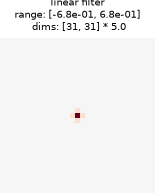
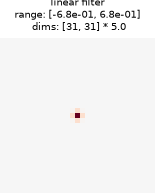
- display_filters(vrange='indep0', zoom=5.0, title='linear filter', **kwargs)[source]#
Display convolutional filter of model.
- Parameters:
vrange (
tuple[float,float] |str(default:'indep0')) – Arguments forimshow, see its docstrings for details.zoom (
float|None(default:5.0)) – Arguments forimshow, see its docstrings for details.title (
str|list[str] |None(default:'linear filter')) – Arguments forimshow, see its docstrings for details.
- Return type:
- Returns:
fig – The figure containing the image.
Examples
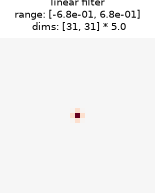
>>> import plenoptic as po
>>> ln_model = po.models.LinearNonlinear(31, pretrained=True, cache_filt=True)
>>> ln_model.display_filters()
<PyrFigure ...>
- forward(x)[source]#
Compute model response on input tensor.
We use same-padding to ensure that the output and input shapes are matched.
- Parameters:
x (
Tensor) – The input tensor, should be 4d (batch, channel, height, width).- Return type:
- Returns:
y – Model response to input.
Examples
>>> import plenoptic as po
>>> ln_model = po.models.LinearNonlinear(31, pretrained=True, cache_filt=True)
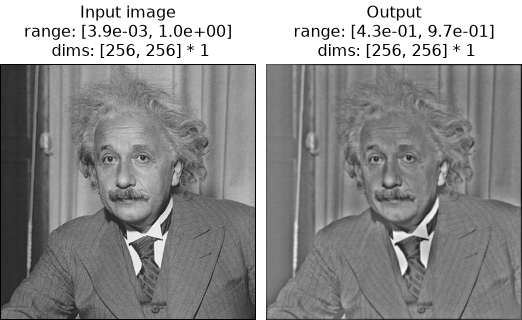
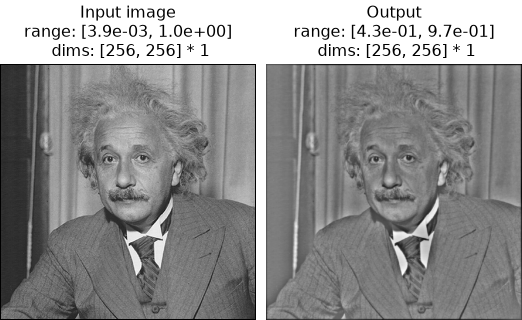
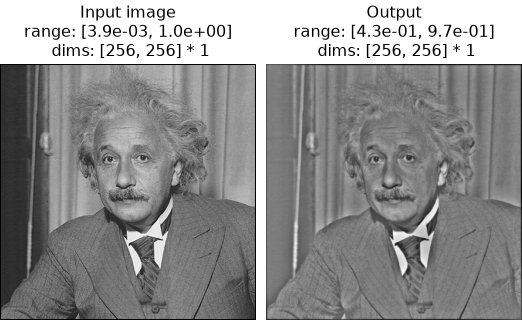
>>> img = po.data.einstein()
>>> y = ln_model.forward(img)
>>> titles = ["Input image", "Output"]
>>> po.plot.imshow([img, y], title=titles)
<PyrFigure size...>