
plenoptic.process.variance#
- plenoptic.process.variance(x, mean=None, dim=None, keepdim=False)[source]#
Calculate sample variance.
Note that this is the uncorrected, or sample, variance, corresponding to
torch.var(*, correction=0).- Parameters:
- Return type:
- Returns:
out – The variance tensor.
Examples
>>> import plenoptic as po
>>> import matplotlib.pyplot as plt
>>> import torch
>>> po.set_seed(42)
>>> x = torch.randn(10000)
>>> v = po.process.variance(x)
>>> x_more = x * 3
>>> v_more = po.process.variance(x_more)
>>> x_less = x * 0.3
>>> v_less = po.process.variance(x_less)
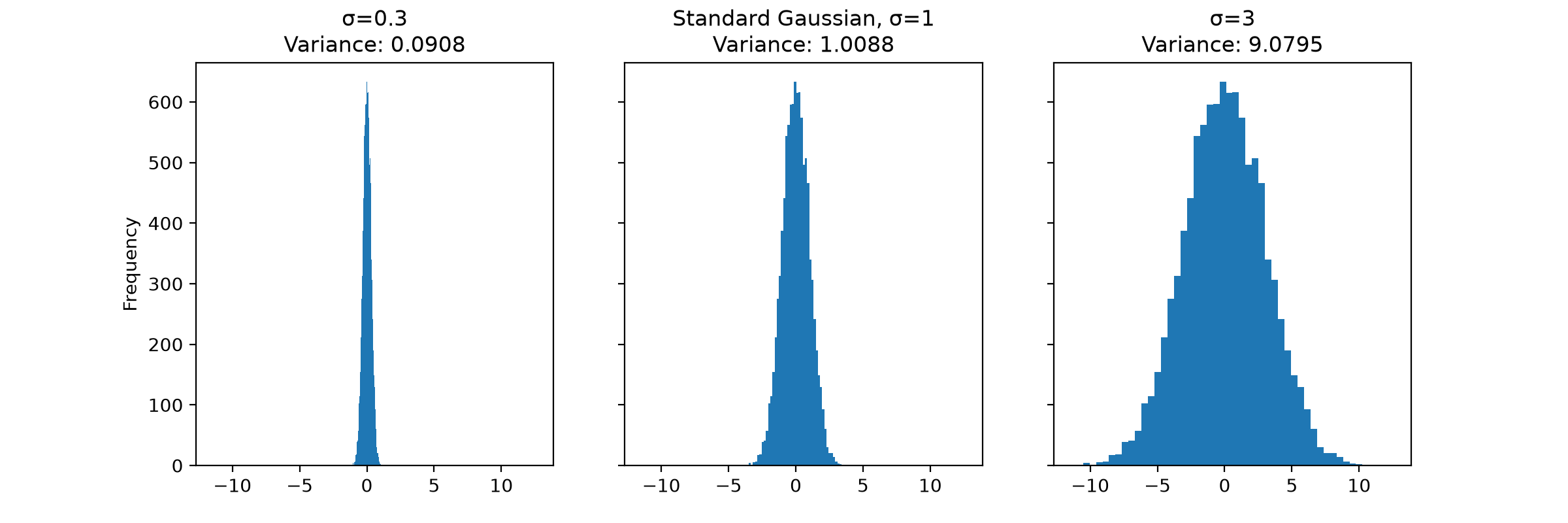
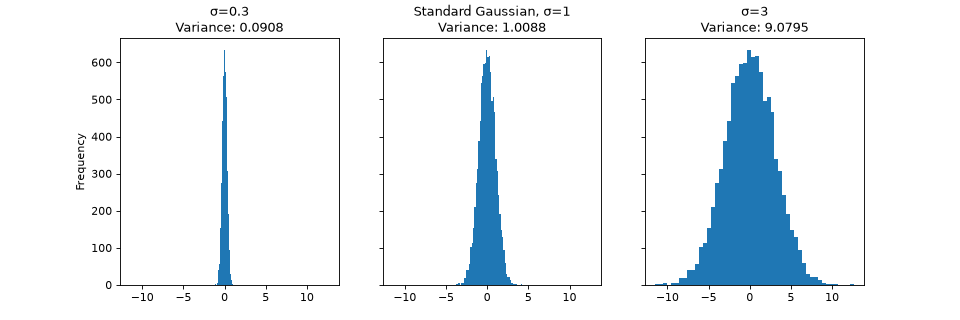
>>> fig, (ax_less, ax, ax_more) = plt.subplots(
...     1, 3, sharex=True, sharey=True, figsize=(12, 4)
... )
>>> _ = ax_less.hist(x_less, bins=50)
>>> _ = ax_less.set(title=f"σ=0.3\nVariance: {v_less:.4f}", ylabel="Frequency")
>>> _ = ax.hist(x, bins=50)
>>> _ = ax.set(title=f"Standard Gaussian, σ=1\nVariance: {v:.4f}")
>>> _ = ax_more.hist(x_more, bins=50)
>>> _ = ax_more.set(title=f"σ=3\nVariance: {v_more:.4f}")
If you have precomputed the mean, you can pass it and avoid recomputing it:
>>> precomputed_mean = torch.mean(x)
>>> v = po.process.variance(x, mean=precomputed_mean)
>>> v
tensor(1.0088)
If you want to compute along a specific dimension, you can specify it:
>>> x = torch.randn(10000, 2)
>>> v = po.process.variance(x, dim=0)
>>> v
tensor([1.0127, 1.0045])
This function differs from
torch.varin that it does not apply a correction:>>> plenoptic_v_corrected = v * x.shape[0] / (x.shape[0] - 1) >>> torch_v = torch.var(x, dim=0) >>> torch.isclose(plenoptic_v_corrected, torch_v) tensor([True, True])