
plenoptic.process.skew#
- plenoptic.process.skew(x, mean=None, var=None, dim=None, keepdim=False)[source]#
Calculate sample estimate of asymmetry about input’s mean.
To help with interpretation:
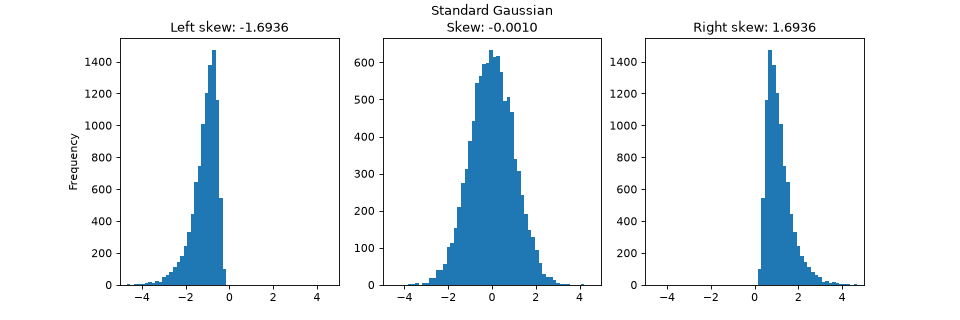
Skew of normal distribution is 0.
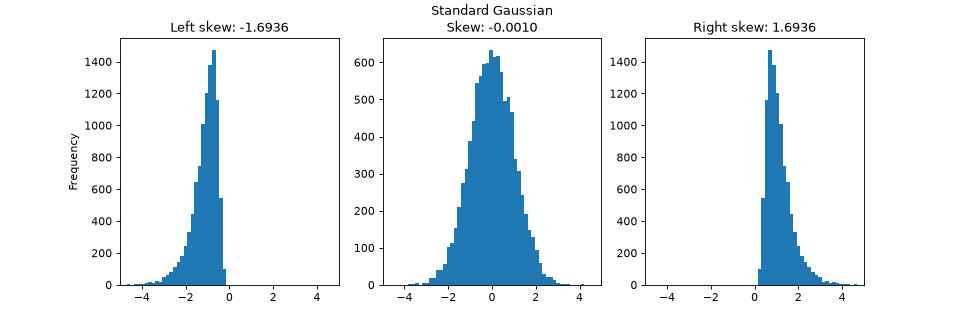
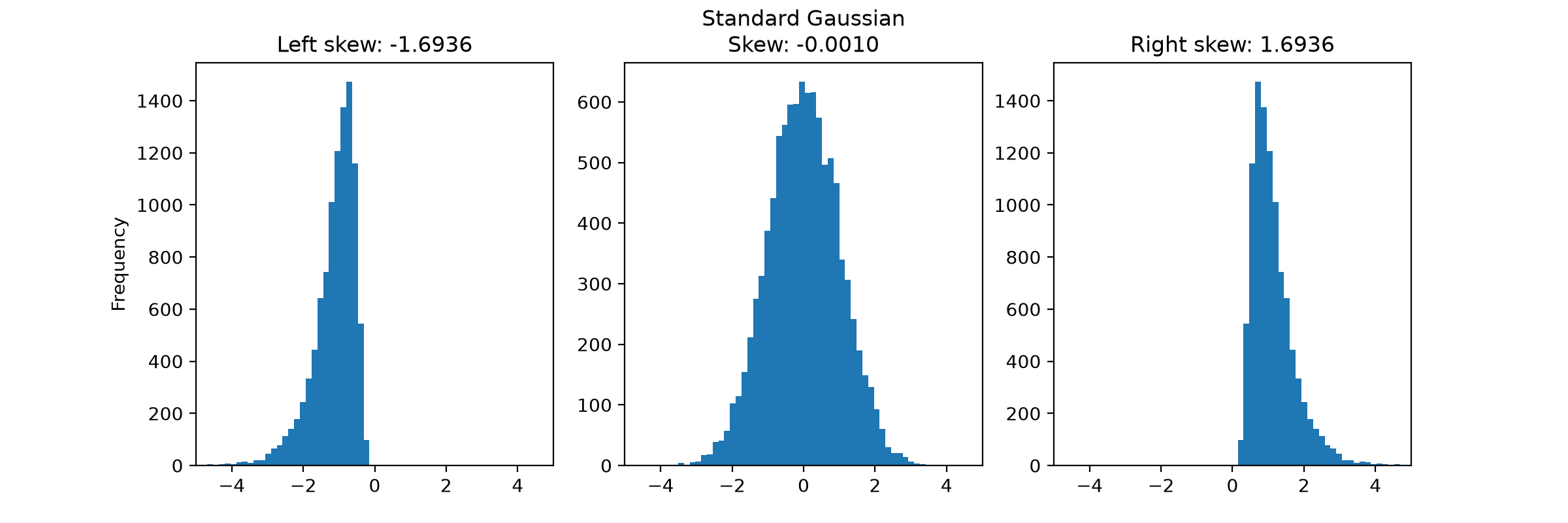
Negative skew, also known as left-skewed: the left tail is longer. Distribution appears as a right-leaning curve.
Positive skew, also known as right-skewed: the right tail is longer. Distribution appears as a left-leaning curve.
- Parameters:
x (
Tensor) – The input tensor.mean (
float|Tensor|None(default:None)) – Reuse a precomputed mean.var (
float|Tensor|None(default:None)) – Reuse a precomputed variance.dim (
int|list[int] |None(default:None)) – The dimension or dimensions to reduce.keepdim (
bool(default:False)) – Whether to retain the reduced dimensions (as singletons) or not.
- Return type:
- Returns:
out – The skewness tensor.
Examples
>>> import plenoptic as po
>>> import matplotlib.pyplot as plt
>>> import torch
>>> po.set_seed(42)
>>> x = torch.randn(10000)
>>> s = po.process.skew(x)
>>> x_right = torch.exp(x / 2)
>>> s_right = po.process.skew(x_right)
>>> x_left = -torch.exp(x / 2)
>>> s_left = po.process.skew(x_left)
>>> fig, (ax_left, ax, ax_right) = plt.subplots(
...     1, 3, sharex=True, figsize=(12, 4)
... )
>>> _ = ax_left.hist(x_left, bins=50)
>>> _ = ax_left.set(
...     title=f"Left skew: {s_left:.4f}", ylabel="Frequency", xlim=(-5, 5)
... )
>>> _ = ax.hist(x, bins=50)
>>> _ = ax.set(title=f"Standard Gaussian\nSkew: {s:.4f}")
>>> _ = ax_right.hist(x_right, bins=50)
>>> _ = ax_right.set(title=f"Right skew: {s_right:.4f}")
If you have precomputed the mean and/or variance, you can pass them and avoid recomputing:
>>> precomputed_mean = torch.mean(x)
>>> precomputed_var = variance(x)
>>> s = po.process.skew(x, mean=precomputed_mean, var=precomputed_var)
>>> s
tensor(-0.0010)
If you want to compute along a specific dimension, you can specify it:
>>> x = torch.randn(10000, 2)
>>> s = po.process.skew(x, dim=0)
>>> s
tensor([-0.0257, -0.0063])