
plenoptic.process.circular_gaussian2d#
- plenoptic.process.circular_gaussian2d(kernel_size, std, out_channels=None)[source]#
Create normalized, centered circular 2D gaussian tensor with which to convolve.
The filter is normalized by total pixel-sum (not by
2*pi*std) and has shape(out_channels, 1, height, width). For 2d convolutions in torch, the first dimensions of the filter tensor corresponds toout_channelsand the second toin_channels, seetorch.nn.Conv2dfor more details.- Parameters:
kernel_size (
int|tuple[int,int]) – Filter kernel size. Recommended to be odd so that kernel is properly centered. If you use same-padding, convolution with an odd-length kernel will be faster, seetorch.nn.functional.conv2d.std (
int|list[int] |float|list[float] |Tensor) – Standard deviation of 2D circular Gaussian. If a scalar andout_channelsis notNone, all out channels will have the same value. If not a scalar andout_channelsis notNone,len(std)must equalout_channels.out_channels (
int|None(default:None)) – Number of output channels. IfNone, inferred from shape ofstd.
- Return type:
- Returns:
filt – Circular gaussian kernel.
- Raises:
ValueError – If out_channels is not a positive integer.
ValueError – If kernel_size is not one or two positive integers.
ValueError – If std is not positive.
ValueError – If std is non-scalar and
len(std) != out_channels
See also
GaussianTorch Module to perform this convolution.
Examples
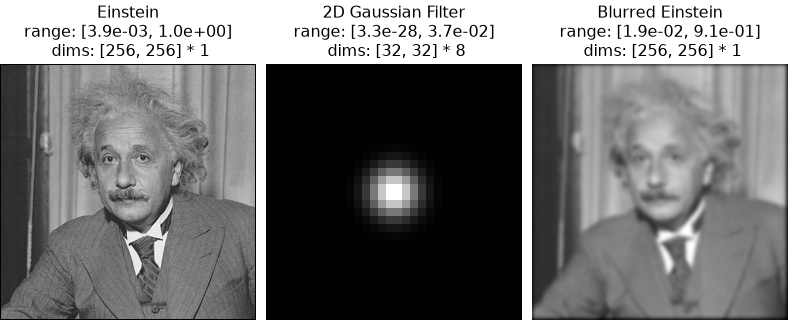
Single output channel.
>>> import plenoptic as po
>>> from torch.nn.functional import conv2d
>>> import torch
>>> import matplotlib.pyplot as plt
>>> kernel_size = 32
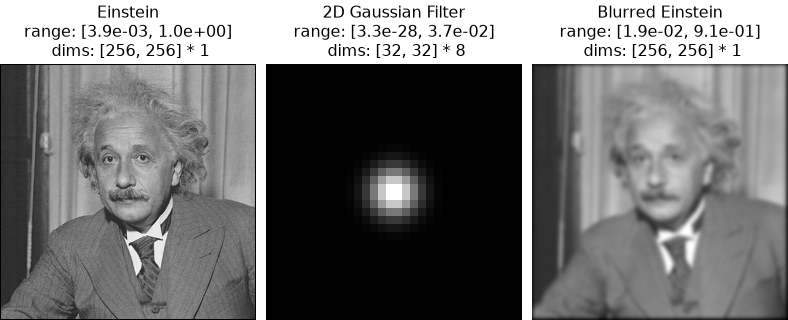
>>> filt_2d = po.process.circular_gaussian2d(kernel_size=kernel_size, std=2)
>>> filt_2d.shape
torch.Size([1, 1, 32, 32])
>>> einstein_img = po.data.einstein()
>>> blurred_einstein = conv2d(einstein_img, filt_2d, padding="same")
>>> po.plot.imshow(
...     [einstein_img, filt_2d, blurred_einstein],
...     title=["Einstein", "2D Gaussian Filter", "Blurred Einstein"],
... )
<PyrFigure ...>
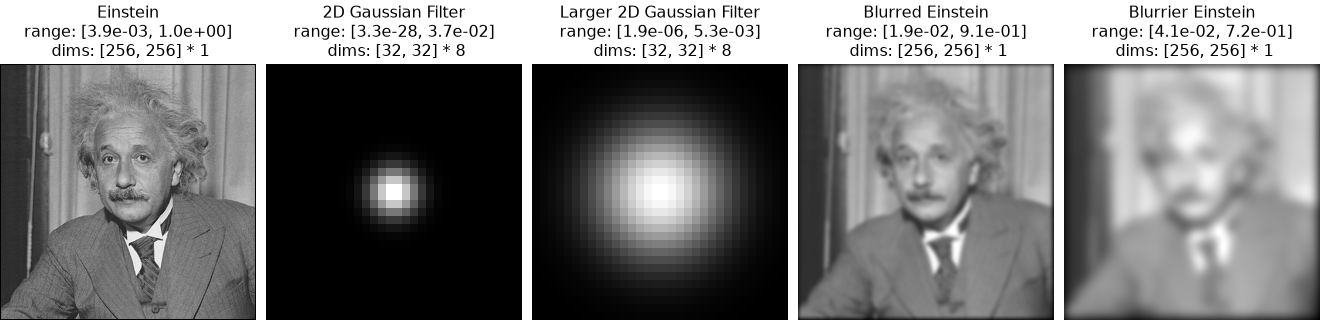
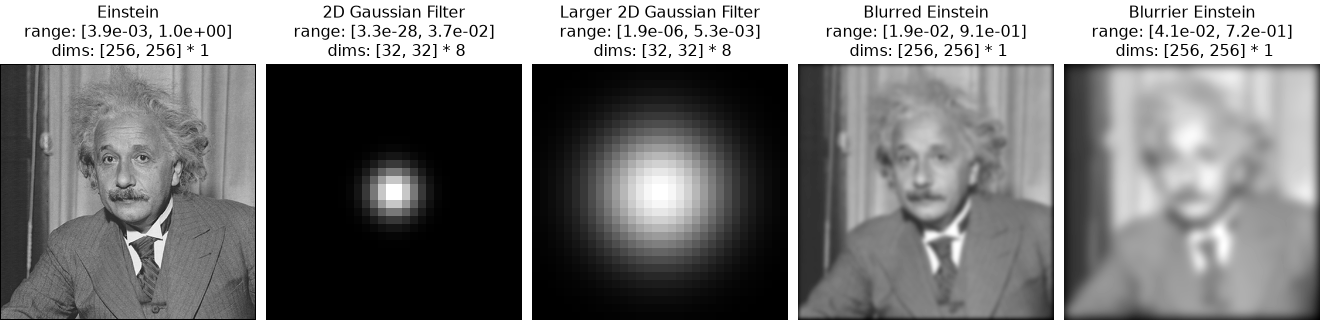
Multiple output channels with different standard deviations.
>>> kernel_size = 32
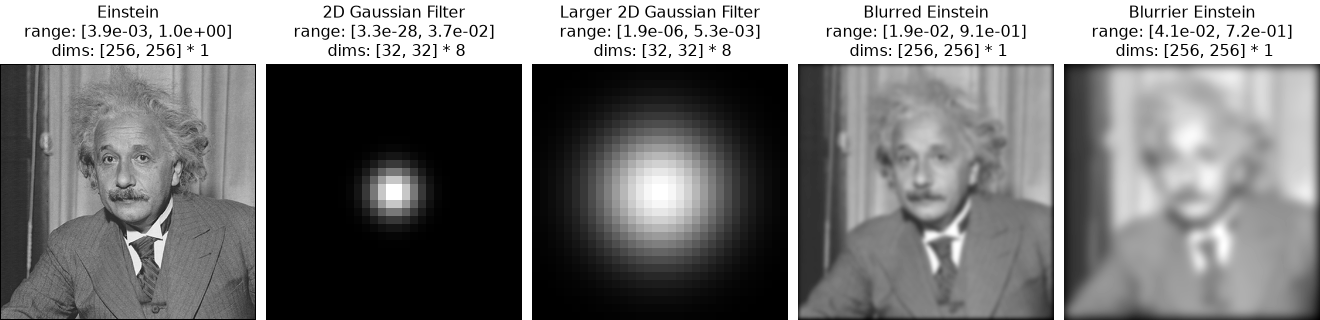
>>> filt_2d = po.process.circular_gaussian2d(
...     kernel_size=kernel_size, std=[2, 5.5], out_channels=2
... )
>>> filt_2d.shape
torch.Size([2, 1, 32, 32])
>>> einstein_img = po.data.einstein()
>>> blurred_einstein = conv2d(einstein_img, filt_2d, padding="same")
>>> titles = [
...     "Einstein",
...     "2D Gaussian Filter",
...     "Larger 2D Gaussian Filter",
...     "Blurred Einstein",
...     "Blurrier Einstein",
... ]
>>> po.plot.imshow([einstein_img, filt_2d, blurred_einstein], title=titles)
<PyrFigure ...>
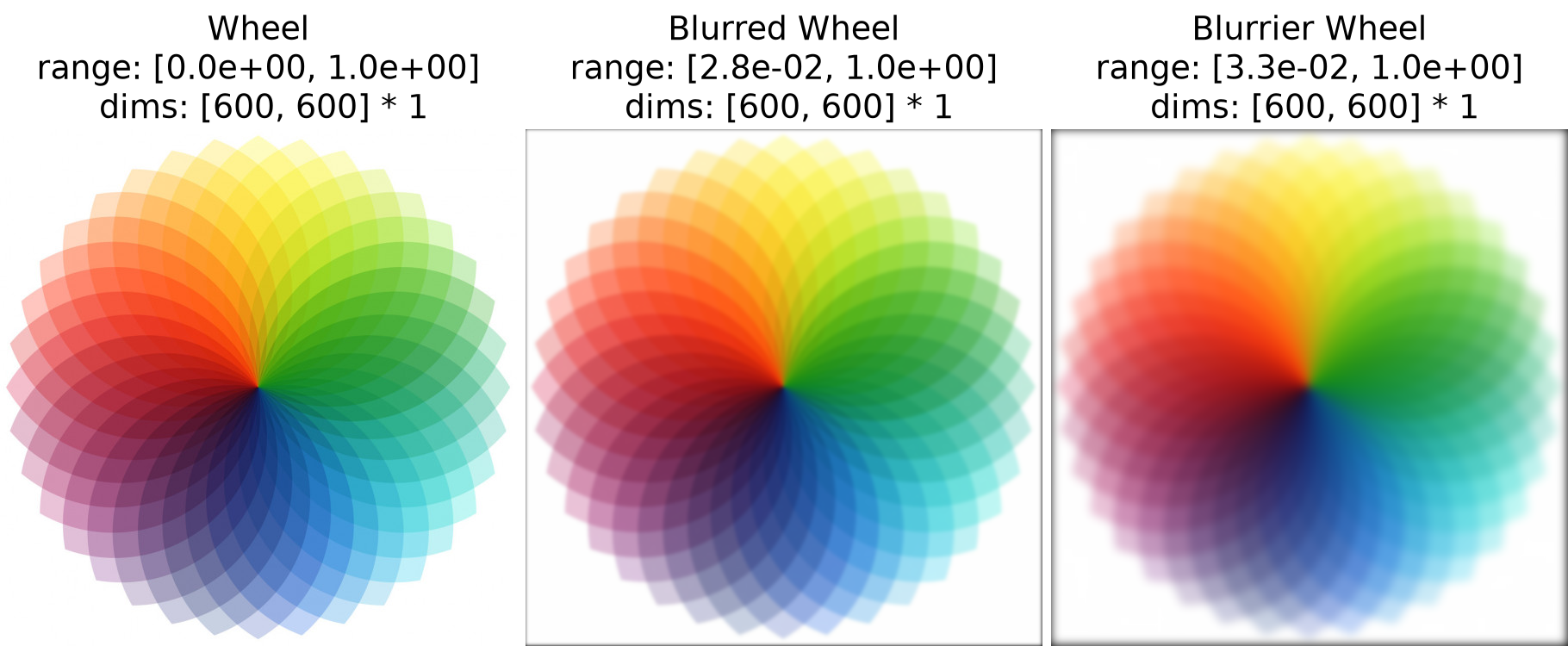
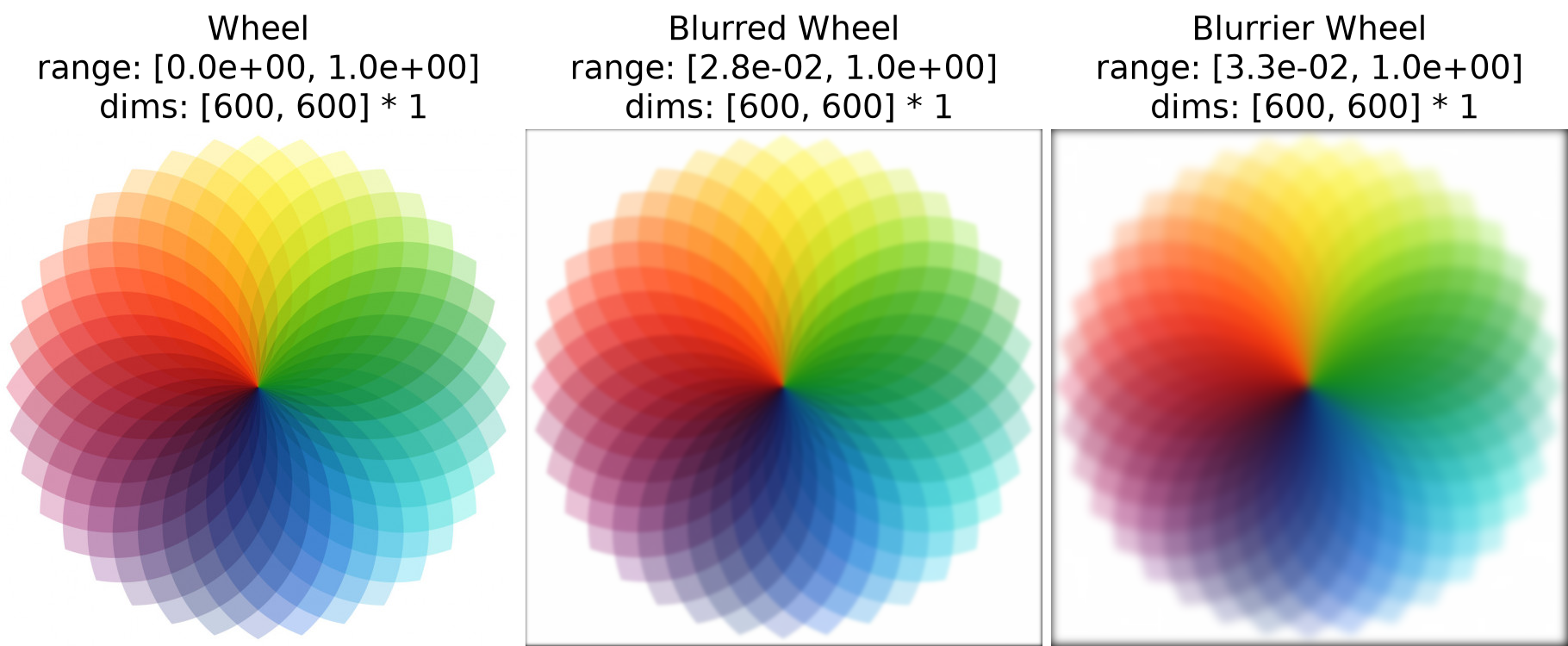
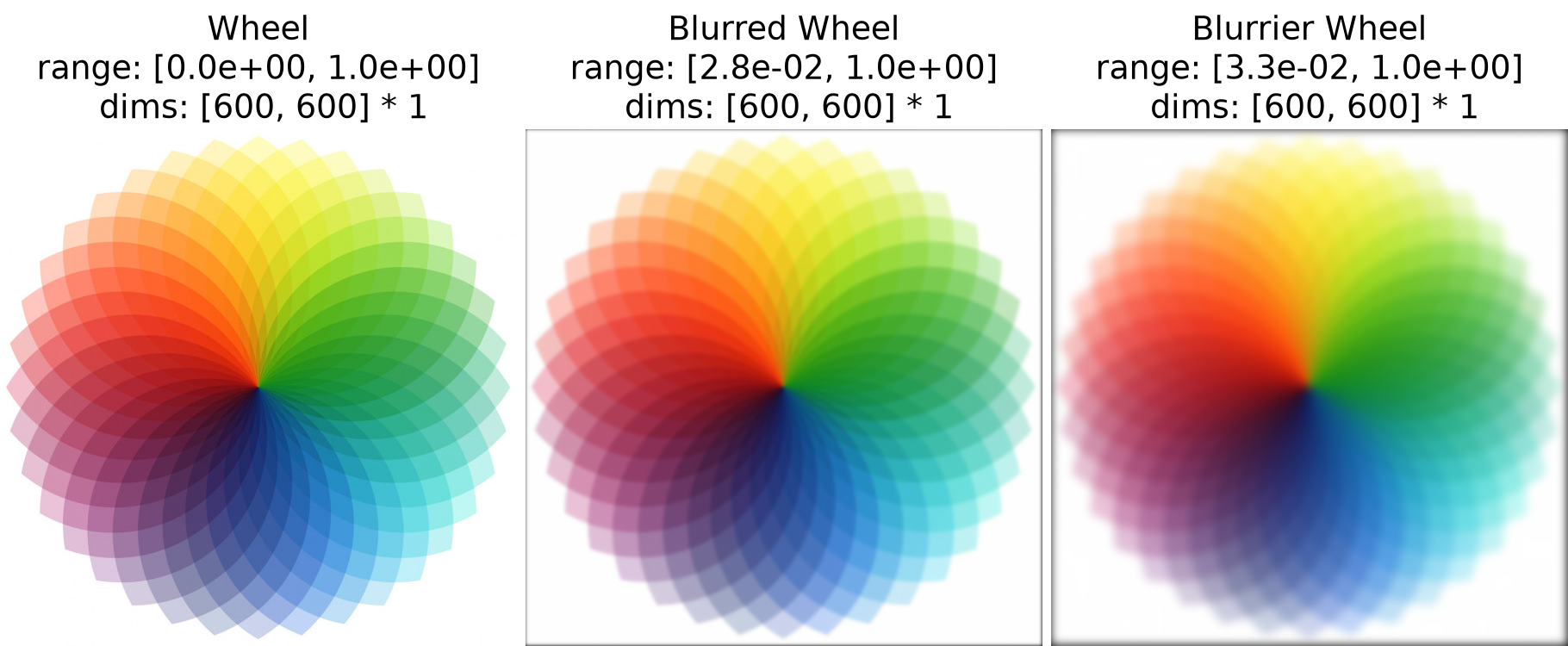
Multiple input and output channels, convolved independently. See
torch.nn.functional.conv2dto understand the behavior below:>>> kernel_size = 32 >>> filt_2d = po.process.circular_gaussian2d( ... kernel_size=kernel_size, std=[2, 5.5], out_channels=2 ... ).repeat(3, 1, 1, 1) >>> filt_2d.shape torch.Size([6, 1, 32, 32]) >>> wheel = po.data.color_wheel(as_gray=False) >>> blurred_wheel = conv2d(wheel, filt_2d, groups=3, padding="same") >>> titles = ["Wheel", "Blurred Wheel", "Blurrier Wheel"] >>> # note that the order of channels: the first two correspond to the first >>> # channel of the input image, convolved with the each of the two gaussians, >>> # and so on. >>> po.plot.imshow( ... [wheel, blurred_wheel[:, ::2], blurred_wheel[:, 1::2]], ... title=titles, ... as_rgb=True, ... ) <PyrFigure ...>