
plenoptic.plot.imshow#
- plenoptic.plot.imshow(image, vrange='indep1', zoom=None, title='', col_wrap=None, ax=None, cmap=None, plot_complex='rectangular', batch_idx=None, channel_idx=None, as_rgb=False, **kwargs)[source]#
Show image(s), avoiding interpolation.
This function shows images carefully, avoiding interpolation: each element in the input
imagewill correspond to a pixel or an integer number of pixels. Whenzoom<1, an integer number of input elements will be averaged into a single pixel.- Parameters:
image (
Tensor|list[Tensor]) – The images to display. Tensors should be 4d (batch, channel, height, width). List of tensors should be used for tensors of different height and width: all images will automatically be rescaled so they’re displayed at the same height and width, thus, their heights and widths must be scalar multiples of each other.vrange (
tuple[float,float] |str(default:'indep1')) –If a 2-tuple, specifies the image values vmin/vmax that are mapped to the minimum and maximum value of the colormap, respectively. If a string:
"auto0": All images have same vmin/vmax, which have the same absolute value, and come from the minimum or maximum across all images, whichever has the larger absolute value."auto1": All images have same vmin/vmax, which are the minimum/maximum values across all images."auto2": All images have same vmin/vmax, which are the mean (across all images) minus/ plus 2 std dev (across all images)."auto3": All images have same vmin/vmax, chosen so as to map the 10th/90th percentile values to the 10th/90th percentile of the display intensity range. For example: vmin is the 10th percentile image value minus 1/8 times the difference between the 90th and 10th percentile."indep0": Each image has an independent vmin/vmax, which have the same absolute value, which comes from either their minimum or maximum value, whichever has the larger absolute value."indep1": Each image has an independent vmin/vmax, which are their minimum/maximum values."indep2": Each image has an independent vmin/vmax, which is their mean minus/plus 2 std dev."indep3": Each image has an independent vmin/vmax, chosen so that the 10th/90th percentile values map to the 10th/90th percentile intensities.
zoom (
float|None(default:None)) – Ratio of display pixels to image pixels. If greater than 1, must be an integer. If less than 1, must be1/dwheredis a a divisor of the size of the largest image. IfNone, we try to determine the best zoom.title (
str|list[str] |None(default:'')) –Title for the plot. In addition to the specified title, we add a subtitle giving the plotted range and dimensionality (with zoom).
If
str, will put the same title on every plot.If
list, all values must bestr, must be the same length as img, and each title will be assigned to corresponding plot.If
None, no title will be printed and subtitle will be removed.
col_wrap (
int|None(default:None)) – Number of axes to have in each row. IfNone, will fit all axes in a single row.ax (
Axes|None(default:None)) – IfNone, we make the appropriate figure. Otherwise, we shrink the axes so that it’s the appropriate number of pixels.cmap (
Colormap|None(default:None)) – Colormap to use when showing these images. IfNone, then behavior is determined byvrange: ifvmap in ["auto0", "indep0"], we use"RdBu_r", else we use"gray"(see matplotlib documentation).plot_complex (
Literal['rectangular','polar','logpolar'] (default:'rectangular')) –Specifies handling of complex values.
"rectangular": plot real and imaginary components as separate images."polar": plot amplitude and phase as separate images."logpolar": plot log (base 2) amplitude and phase as separate images.
batch_idx (
int|None(default:None)) – Which element from the batch dimension to plot. IfNone, we plot all.channel_idx (
int|None(default:None)) – Which element from the channel dimension to plot. IfNone, we plot all. Note if this is notNone, thenas_rgb=Truewill fail, because we restrict the channels.as_rgb (
bool(default:False)) – Whether to consider the channels as encoding RGB(A) values. IfTrue, we attempt to plot the image in color, so your tensor must have 3 (or 4 if you want the alpha channel) elements in the channel dimension. IfFalse, we plot each channel as a separate grayscale image.**kwargs (
Any) – Passed tomatplotlib.pyplot.imshow.
- Return type:
- Returns:
fig – Figure containing the plotted images.
- Raises:
ValueError – If
imagesis not a 4d tensor or list of 4d tensors.TypeError – If
batch_idxorchannel_idxare not an int orNone.IndexError – If
batch_idxorchannel_idxare out of bounds.ValueError – If
zoomtakes an illegal value.ValueError – If
as_rgb=Trueand the inputimagedoes not have 3 or 4 channels.ValueError – If
as_rgb=False,imagehas more than one channel and one more than one batch and neitherbatch_idxnorchannel_idxis set.Exception – If
plot_complextakes an illegal value.
See also
synthesis_imshowShow the image synthesized by a synthesis object.
animshowAnimate a video.
pyrshowDisplay steerable pyramid coefficients.
Notes
This interpolation avoidance is only guaranteed for the saved image; it should generally hold in notebooks as well, but will fail if, e.g., you plot an image that’s 2000 pixels wide on an monitor 1000 pixels wide; the browser handles the rescaling in a way we can’t control.
Examples
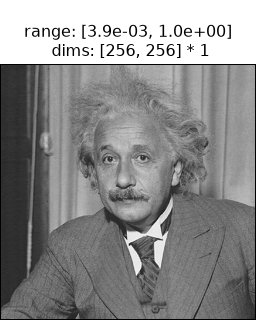
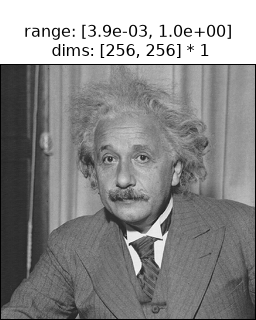
Plot a single grayscale image:
>>> import plenoptic as po
>>> einstein = po.data.einstein()
>>> einstein.shape
torch.Size([1, 1, 256, 256])
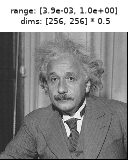
>>> po.plot.imshow(einstein)
<PyrFigure size ... with 1 Axes>
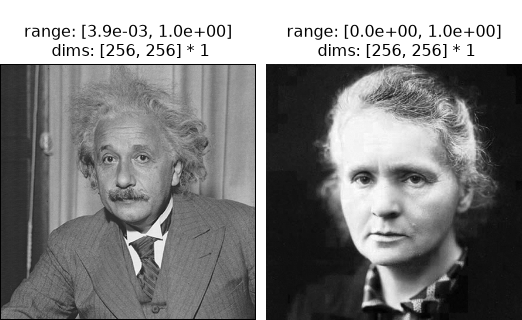
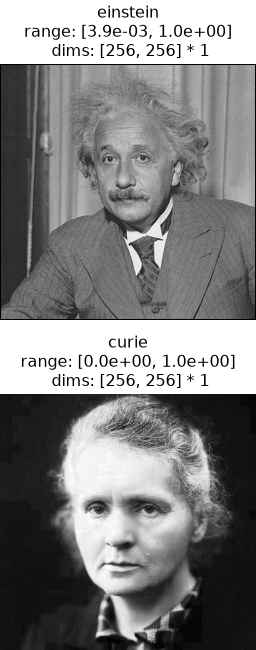
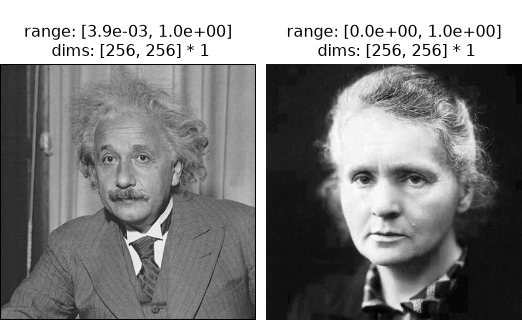
For an image tensor with multiple elements along the batch dimension and a single channel element, this function will plot each batch independently as grayscale images:
>>> import torch
>>> curie = po.data.curie()
>>> imgs = torch.cat([einstein, curie])
>>> print(imgs.shape)
torch.Size([2, 1, 256, 256])
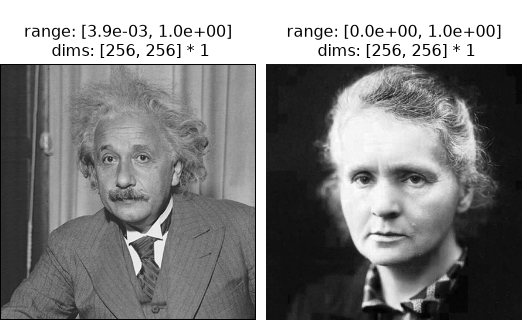
>>> po.plot.imshow(imgs)
<PyrFigure size ... with 2 Axes>
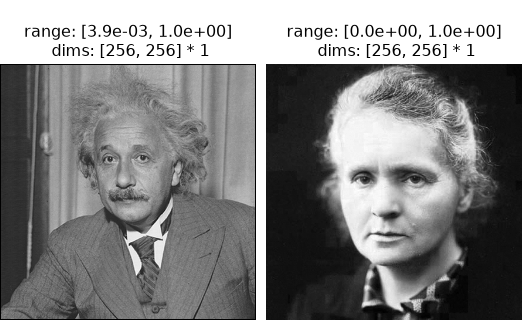
A list of 4d tensors will be concatenated along the batch dimension before plotting. Thus, the following example is the same as above:
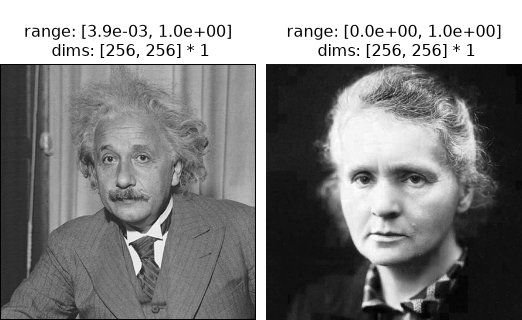
>>> po.plot.imshow([einstein, curie])
<PyrFigure size ... with 2 Axes>
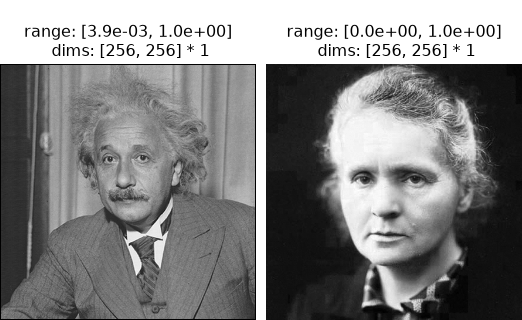
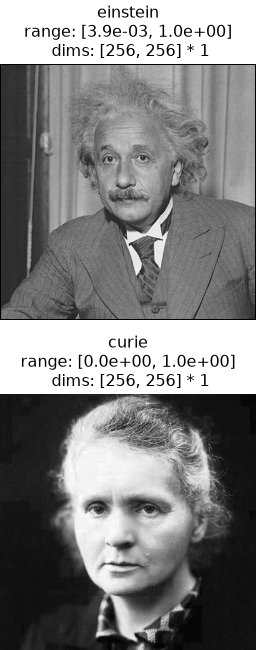
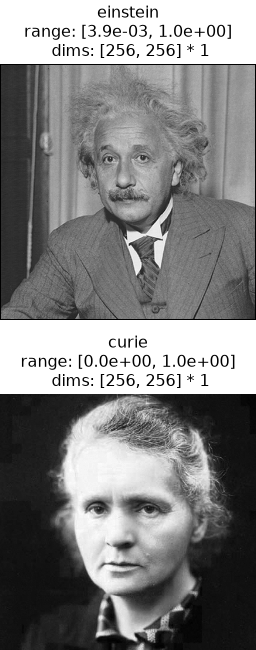
You may use the
titleargument for any number of images, either as a string applied to all images or as a list the length of images. Additionally,col_wrapspecifies the number of images per row:>>> po.plot.imshow(imgs, title=["einstein", "curie"], col_wrap=1) <PyrFigure size ... with 2 Axes>
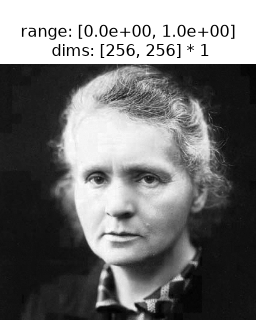
Specifying
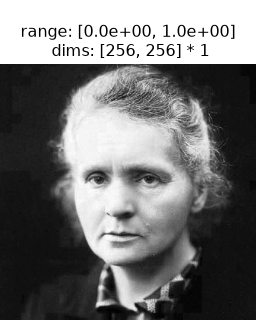
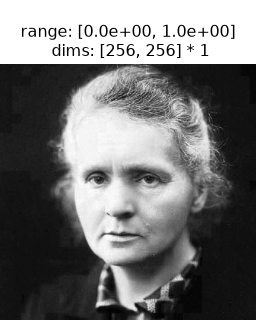
batch_idxwill plot the corresponding element in the batch dimension (i.e.,imgs[batch_idx]):>>> print(imgs.shape) torch.Size([2, 1, 256, 256]) >>> po.plot.imshow(imgs, batch_idx=1) <PyrFigure size ... with 1 Axes>
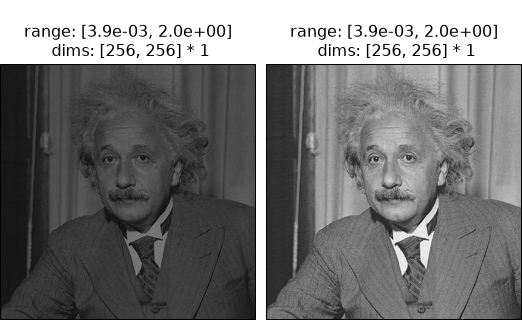
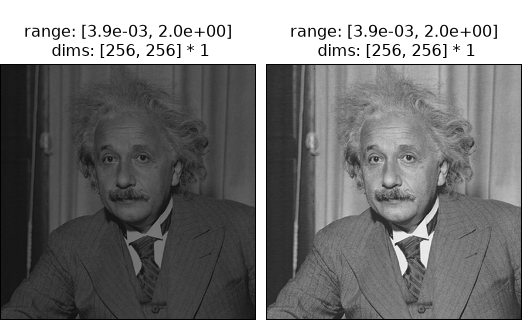
The vrange argument allows control over the min and max values of the color range. In addition to a 2-tuple of floats, this functions accepts several special strings (see docstring for details). For example,
"auto1"sets all images to have the same range:>>> einsteins_scaled = torch.cat([einstein, einstein * 2]) >>> po.plot.imshow(einsteins_scaled, vrange="auto1") <PyrFigure size ... with 2 Axes>
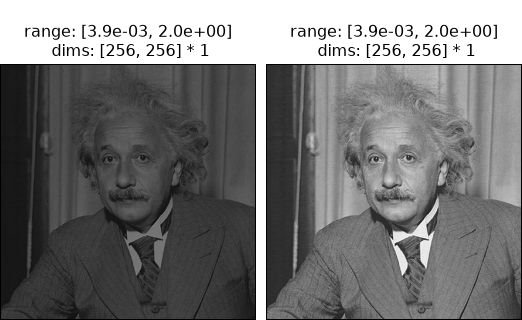
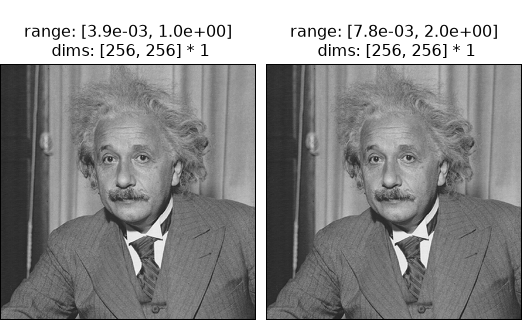
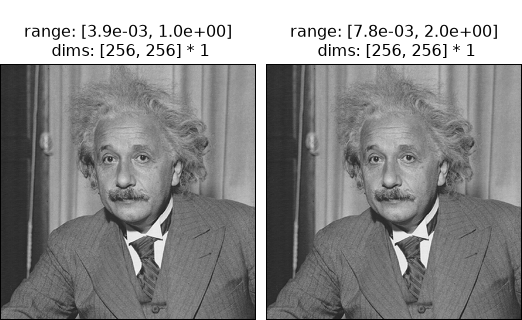
Meanwhile,
"indep1"sets each image’s range independently. Note the different ranges in the titles!>>> po.plot.imshow(einsteins_scaled, vrange="indep1") <PyrFigure size ... with 2 Axes>
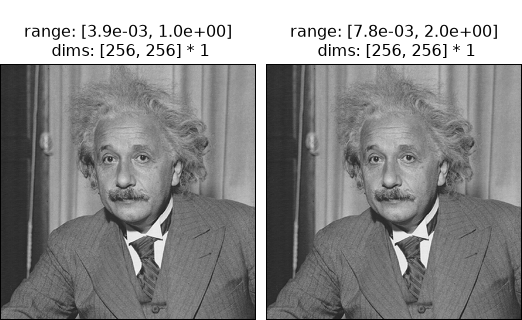
The
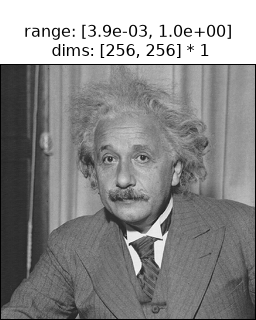
zoomargument allows users to set the ratio of display to image pixels, increasing or decreasing the size of the resulting plot:>>> po.plot.imshow(einstein, zoom=0.5) <PyrFigure size ... with 1 Axes>
Note that if
zoom<1and the value is not a divisor of the largest image size, this function will raise an error:>>> print(einstein.shape) torch.Size([1, 1, 256, 256]) >>> po.plot.imshow(einstein, zoom=0.7) Traceback (most recent call last): Exception: zoom * signal.shape must result in integers!
You can use the
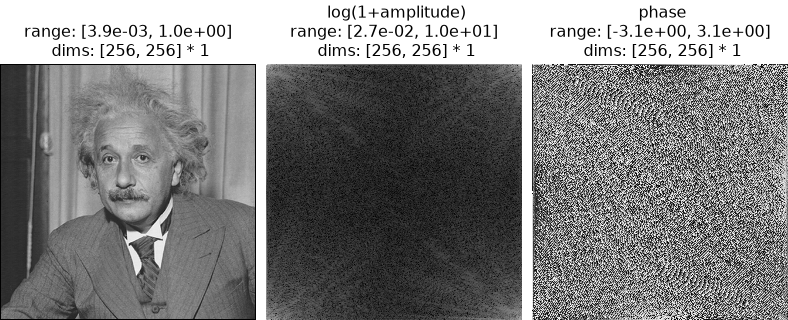
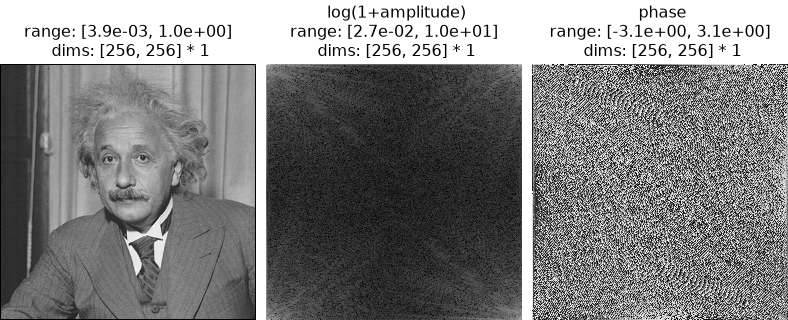
plot_complexargument to control how complex tensors are plotted:>>> einstein_fft = torch.fft.fft2(einstein) >>> po.plot.imshow([einstein, einstein_fft], plot_complex="logpolar") <PyrFigure size ... with 3 Axes>
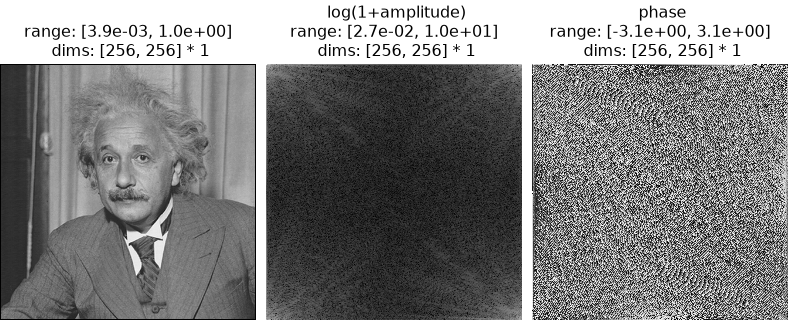
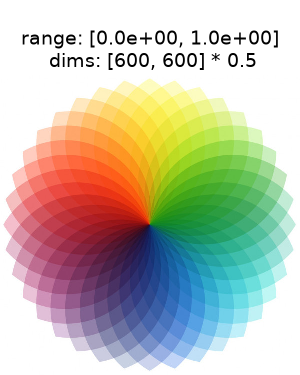
To plot a RGB(A) image in color, you must set
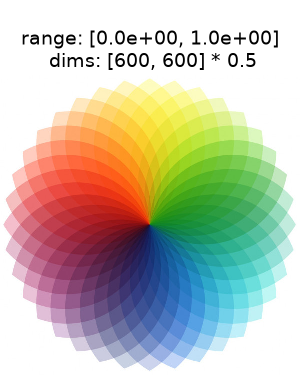
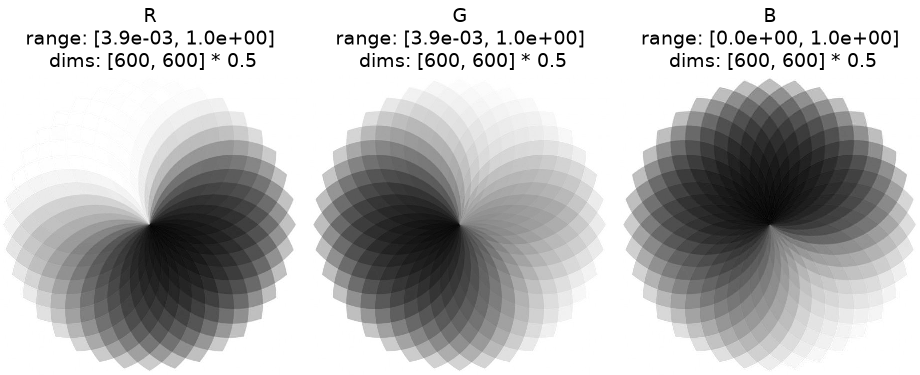
as_rgb=True:>>> color_wheel = po.data.color_wheel() >>> print(color_wheel.shape) torch.Size([1, 3, 600, 600]) >>> po.plot.imshow(color_wheel, as_rgb=True, zoom=0.5) <PyrFigure size ... with 1 Axes>
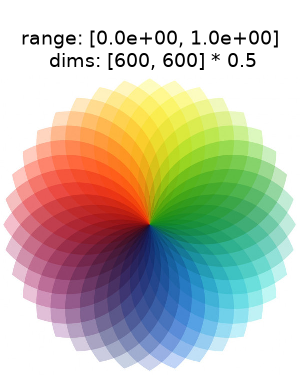
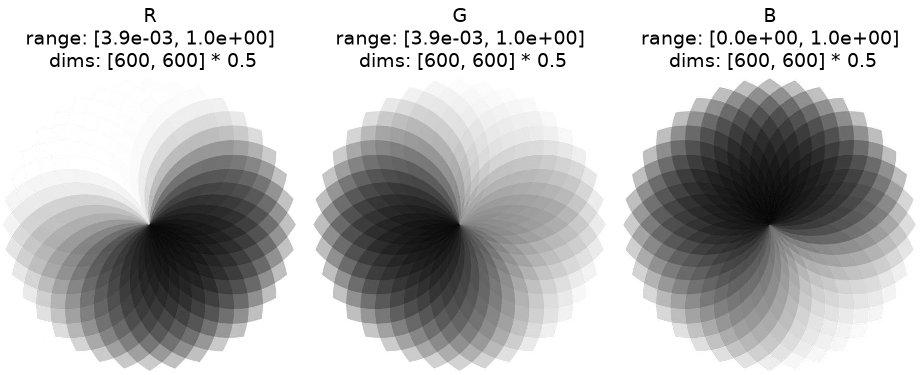
Otherwise, images with multiple channels will have each channel plotted as a separate grayscale image:
>>> po.plot.imshow(color_wheel, zoom=0.5, title=["R", "G", "B"])
<PyrFigure size ... with 3 Axes>
This function will raise a
ValueErrorifas_rgb=Trueand the input image doesn’t have the required number of channels:>>> print(einstein.shape) torch.Size([1, 1, 256, 256]) >>> po.plot.imshow(einstein, as_rgb=True) Traceback (most recent call last): ValueError: If as_rgb is True, then channel must have 3 or 4 elements!
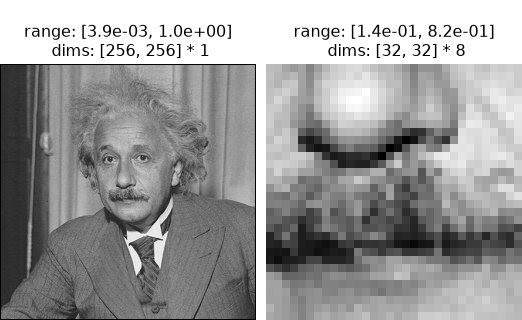
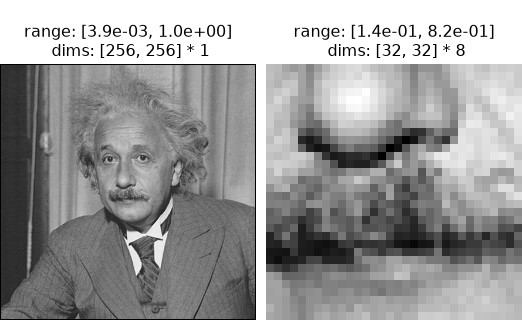
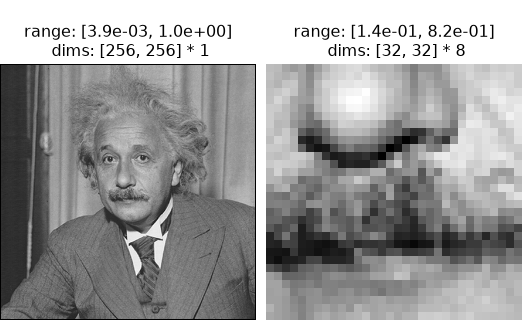
Images will be automatically rescaled to be displayed at the same heights and widths if sizes are scalar multiples of each other:
>>> einstein_cropped = po.process.center_crop(einstein, 32)
>>> po.plot.imshow([einstein, einstein_cropped])
<PyrFigure size ... with 2 Axes>